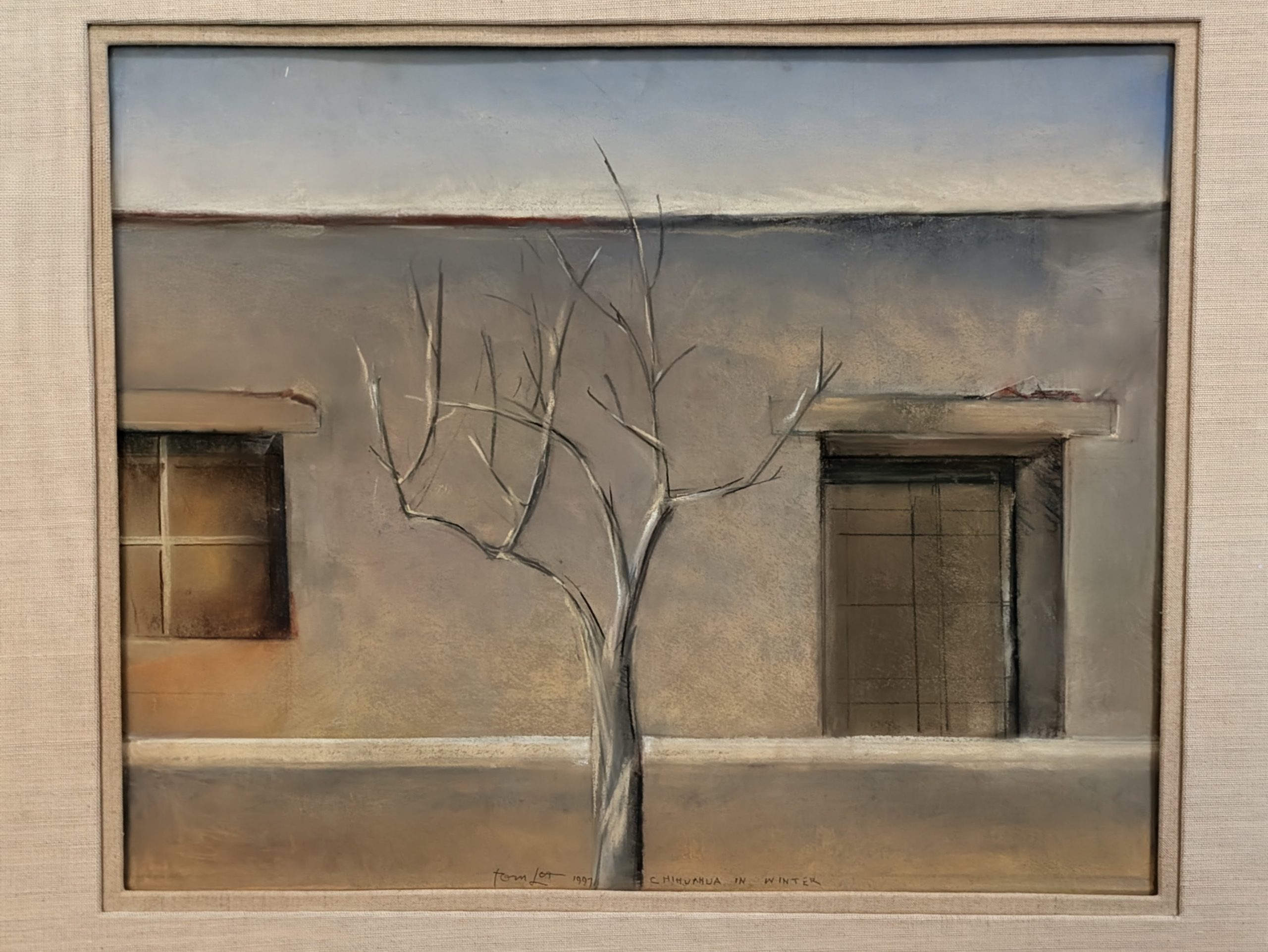
The following is taken from the story recounting the creation of the piece “Chihuahua in Winter” by artist Tom Lea, 1997. From Adair Margo who wrote his biography.
“In January of 1997, Sarah and Tom Lea joined the First Lady of Texas at the time, Laura Bush, Secretary of State Tony Garza and some El Paso friends to visit Casas Grandes, Chihuahua. A side trip took him and his friends to Mata Ortiz, the home of the famed Mexican potter, Juan Quezada, and his family. As the group was leaving the village, Lea spotted this adobe with a dry tree. He asked the driver to stop so that he could sketch what he saw.
Upon returning home, Tom Lea completed this pastel. It is his last work of art.
Life is filled with twists and turns, and the road from the tiny village of Mata Ortiz, Chihuahua, Mexico to an exhibition at the Mexican Cultural Institute in Washington, D.C. was, too. It began when my friend, Laura Bush, expressed an interest in visiting Casas Grandes, Chihuahua when she was First Lady of Texas. She’d read about it in books, and thought it would be fun to experience it first hand. Since El Paso is on the border of Mexico, a drive across the bridge into northern Chihuahua was an easy thing to do.
Sandi Casillas, a kindly art teacher, taught at St. Clement’s Episcopal School across the street from my art gallery and, when she brought students to see exhibitions, she’d sometimes mention trips to Casas Grandes and Paquimé. She even finagled cooking for a pottery workshop given by Juan Quezada in a cave near Mata Ortiz because she would do anything to tag along. Sandi wanted to live in Mexico, and figured out ways to travel there every chance that she could. Of course she would help me plan a trip for Laura Bush and some of her friends, and could she also come along?
Following her hand-drawn map with descriptions of places along the way – Palomas, Ascencion, Janos, Colonia Dublan – we left on the second of January, 1997, a group of thirteen in two sedans with my white suburban bringing up the rear. A First Lady, sculptor, poet, judge, university president, art teacher, businesswoman, Texas Secretary of State, painter and writer were among us, most never having made the trip before. Our two days in Casas Grandes made memories that are with us still, including being with the renowned artist, Tom Lea, who passed away in January 2001.
There was a quietness to the world that winter in Chihuahua, as we had a picnic under dry cottonwoods by a creek bed off the road. Blond children gathered around us speaking old German when we stopped to visit a Mennonite community, and Sandi gave them candy. As we pulled up to the old Luis Terrazzas hacienda where we would stay near the ruins of Paquimé, mariachis played on the covered porch welcoming Laura Bush and her friends.
Light from the sky cast shadows on the earthen ruins of Paquimé and potsherds, barely distinguishable from the dusty ground, were witness to clays nearby and pigments embedded in the rocks. The archeology museum, constructed like an indigenous dwelling growing out of the earth, displayed how ancient people lived, trading parrots and metates along routes from southern Mexico to Chaco Canyon. Their pots were painted with abstract designs of men and women, snakes and birds, earth and sky. Tom Lea was visibly moved as Tony Garza, Texas Secretary of State, pushed him through the museum in a wheelchair and then outside. Like the antepasados (time before) who observed their surroundings long ago, taking cues for their painted designs, Tom Lea looked towards the mountains, and he did not feel alone.
Juan Quezada took the group through his village of Mata Ortiz the next day, pointing out what financial prosperity had brought him – cattle, roosters, a ranch house on the hill- before demonstrating his way of making ollas. He taught himself as a boy, through trial and error, since the ancient tradition had disappeared and there was no one to show him. Outside, plastic cylinders were filled with soaking clay. Wood was stacked by worn adobe walls, and cow manure was gathered in burlap bags – fuel for firings. Inside, Juan formed a flat circle of clay, pressing it into a shallow dish, then placing a thick coil around the edge that looked like a donut. Pinching the clay up, smoothing it as it rose and swelled, Juan Quezada formed an olla that was flawlessly balanced and formed.
Juan’s son, Noe, had finished painting an eggshell white pot with an elegant design of sweeping black arcs and burnt-sienna bands in preparation for our visit. It was ready to be fired. Wondering aloud how such fine lines were painted with pigment and brush on a curved surface, Tom Lea was delighted when Juan explained that, with fine long children’s hair attached to a BIC pen casing, a potter can drag the line. After watching the simple firing in a make-shift kiln or quemador, members of the group walked to other homes in the village, purchasing ollas from dining and kitchen tables, beds, and dressers. There were many houses with hand lettered signs advertising pots for sale. Columned doors, new sofas, televisions and remodeled kitchens hinted at prosperity everywhere. Decades earlier, Juan Quezada began sharing the proceeds from the sale of his ollas with his family, but ended up teaching them to be potters instead.
Before leaving for El Paso, Juan presented Noe’s cooled olla to Laura Bush in his kitchen, a gift she displayed prominently in her office back in Austin. There’s a picture of Juan and a grateful Laura Bush with the olla, standing against a bright turquoise wall. Again and again I returned after that trip, continuing after Laura Bush became First Lady of the United States and Tony Garza Ambassador to Mexico. When Laura’s husband, President George W. Bush, appointed me Chairman of the President’s Committee on the Arts and the Humanities, I decided our focus would be international cultural understanding, beginning with Mexico. Just as Sandi Casillas shared the Chihuahua region of Casas Grandes with me, I began sharing it with newly made friends at the U.S. federal agencies and private members sitting on national boards.
Every trip brought discoveries of change. Hostal de las Guacamayas, a charming bed and breakfast at Paquimé with exquisite ollas in its gallery. Crumbling adobes being restored by Spencer McCallum, renown patron of Juan Quezada and promoter of Mata Ortiz. New restaurants and galleries featuring yet another generation of potters, and other developing crafts, like jewelry made from broken pots. Organized competitions for artists throughout the Gran Chichimeca, drawing regional visitors from several states.
After an April 2007 President’s Committee meeting in El Paso focused on the links between World Heritage Sites Monte Alban, Paquimé and Mesa Verde, I planned another trip. Repeating the route we made with Laura Bush, this time in a fourteen passenger van, members of the President’s Committee on the Arts and the Humanities and Mexican friends from the U.S. Embassy in Mexico and the Cultural Institute in Washington drove west from El Paso to Columbus, New Mexico and then south to Casas Grandes. One visit is all it took for Juan Garcia de Oteyza, Mexican Cultural Attaché to the U.S. at the time, to decide on an exhibition of the Potters of Mata Ortiz. His successor, Alejandra de la Paz agreed, working hard with Mayte Lujan, the owner of Hostal de las Guacamayas, to bring the exhibition to fruition.
When Juan Quezada was a boy, no one would believe that the poor town of Mata Ortiz would one day prosper, and that the First Lady of the United States would delight in his work. Juan changed that by teaching himself to make pots from the materials of the earth, and then sharing what he learned with his family. That sharing extended to the village, and then to the United States and other parts of the world. This extraordinary exhibition at the Mexican Cultural Institute in Washington, D.C. is yet another extension of that sharing.”
- Adair Margo.